Constant criticism in relationships is often minimized because it doesn’t always look dramatic from the outside. There are no obvious blowups. No single moment you can point to and say, “That was it.”
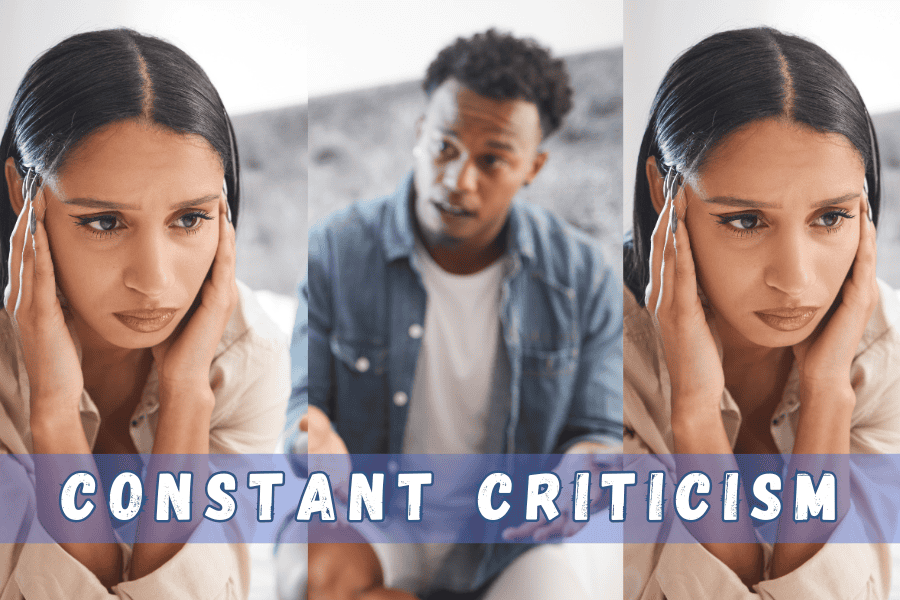
Instead, it’s a steady drip of comments, corrections, and disapproval that slowly wears you down.
Over time, this kind of environment trains you to second-guess yourself before you even speak. You start scanning conversations for what you might do wrong instead of showing up as you are. The emotional toll isn’t loud — but it is heavy, and it accumulates quietly.
This blog post is about recognizing constant criticism in relationships, understanding how it affects your mental health, and learning how to detach, cope, and begin healing from it.
What Constant Criticism Looks Like in Relationships
Constant criticism isn’t always obvious or aggressive.
More often, it blends into everyday interactions so smoothly that you don’t immediately clock it as harmful. It shows up as a pattern — one that slowly reshapes how you move, speak, and think inside the relationship.
It can look like:
- Frequent “suggestions” that feel less like support and more like correction
- Comments framed as concern that consistently land as disappointment
- Repeated focus on what you did wrong, while what you did right goes unnoticed
Over time, you may realize something unsettling:
Nothing you do ever fully resolves the criticism.
There is a clear difference between healthy feedback and chronic criticism.
Healthy communication:
- Addresses specific situations
- Allows room for mistakes
- Does not question your character or emotional validity
Constant criticism:
- Expands beyond behavior and into who you are
- Fixates on your tone, reactions, or emotional responses
- Leaves you feeling evaluated instead of understood
Criticism often hides behind humor, which makes it harder to challenge.
Sarcasm.
Backhanded jokes.
Comments followed by “I’m just being honest.”
When this becomes routine, your nervous system starts anticipating correction before it even happens. You may notice yourself shrinking — not because you want to, but because staying visible feels risky.
Why Some Partners Constantly Criticize
People who constantly criticize are rarely offering guidance.
More often, they are trying to manage their own internal discomfort by controlling the environment around them.
Criticism can stem from:
- Deep insecurity
- Emotional immaturity
- Difficulty regulating stress or frustration
Instead of processing those feelings internally, they project them outward.
Control plays a central role in this dynamic.
By pointing out flaws, a partner can position themselves as more competent, more rational, or more emotionally “together.” This creates an unspoken hierarchy where one person corrects and the other adjusts.
Over time, this imbalance becomes normalized.
You may find yourself:
- Defending neutral choices
- Explaining basic emotions
- Editing yourself to avoid another comment
Criticism can also be a form of emotional projection. When someone is dissatisfied with their life or themselves, directing attention toward a partner provides temporary relief. The criticism distracts them from their own discomfort — even though it transfers the weight onto you.
Understanding this doesn’t excuse the behavior.
But it can help you stop personalizing what was never truly about you.
Effects of Constant Criticism on Mental Health
The mental health impact of constant criticism builds slowly, which is why it’s often overlooked. There’s no clear starting point — just a gradual shift in how safe it feels to exist as yourself.
Anxiety is often the first sign.
You may:
- Rehearse conversations before they happen
- Replay interactions afterward
- Feel tense even during calm moments
Your mind stays alert, scanning for what might be “wrong.”
Over time, self-esteem begins to erode.
Repeated criticism reshapes your internal dialogue. You may start correcting yourself automatically, assuming you’re always one step away from doing something wrong. Confidence doesn’t disappear overnight — it dissolves through repetition.
Emotional shutdown is a common survival response.
When expressing yourself leads to correction or dismissal, silence feels safer. You may stop sharing opinions, feelings, or needs — not because they don’t matter, but because voicing them feels costly.
Eventually, many people develop a fear of self-expression.
When emotions are constantly questioned or reframed as wrong, it becomes easier to stay quiet than to risk being misunderstood again. This isn’t growth or maturity — it’s adaptation to an unsafe dynamic.
Why You Stopped Speaking Up
At some point, many people stop pushing back against constant criticism — not because they agree with it, but because engaging becomes exhausting. When every response is met with correction, reframing, or dismissal, silence starts to feel safer than honesty.
This isn’t weakness.
It’s adaptation.
Repeated criticism teaches you that speaking comes at a cost. You learn, consciously or not, that sharing your thoughts leads to more scrutiny, not understanding. Over time, you may notice yourself editing your words, softening your reactions, or choosing quiet simply to avoid another round of evaluation.
Silence becomes a form of self-protection.
Not because you have nothing to say — but because saying it feels pointless.
Understanding this matters because it reframes what happened. You didn’t “fail to communicate.” You responded to an environment that made communication unsafe. Detachment begins when you stop blaming yourself for survival strategies that once kept you emotionally intact.
How to Cope With Constant Criticism
Coping with constant criticism starts with pattern recognition.
One critical comment does not define a relationship.
A repeated cycle of correction, disapproval, or emotional invalidation does.
Once you recognize the pattern, it becomes harder to excuse it as “just how they are.”
Emotional boundaries are essential here — and they are internal before they are external.
This does not mean:
- Arguing your point harder
- Explaining yourself more clearly
- Trying to be understood by someone committed to misunderstanding you
It means deciding what you will no longer engage with.
You get to choose:
- Which comments deserve a response
- Which ones no longer earn your emotional energy
There is also a moment where explaining yourself becomes self-abandonment.
If you are constantly justifying your feelings, tone, or intentions, the issue is no longer communication — it’s power. Knowing when to stop explaining is often the first act of detachment.
Outside support matters here.
Having your experience reflected back accurately — through journaling, therapy, or a grounded third party — helps restore clarity and reminds you that your reactions make sense.
Signs the Criticism Is No Longer External
Constant criticism does the most damage when it no longer needs to be spoken out loud. Over time, it moves inward — shaping how you think, decide, and respond to yourself.
You may notice signs like these:
- You correct yourself before anyone else does
- You hesitate over small, neutral decisions
- You anticipate disapproval even in calm moments
- You second-guess emotions instead of trusting them
- You feel uneasy expressing needs or preferences
At this stage, the criticism isn’t just something you hear — it’s something you carry. Your internal voice begins to mirror the tone you were exposed to, even when the person is no longer present or actively critical.
Recognizing this shift is important. It’s not a personal flaw — it’s the result of prolonged exposure to correction without emotional safety. Healing begins when you notice what isn’t actually yours and begin separating from it.
Healing From Long-Term Criticism
Healing from long-term criticism isn’t about confrontation or closure.
It’s about rebuilding what slowly eroded while you were busy surviving the dynamic.
Self-worth often needs intentional repair.
When criticism becomes consistent, you learn to measure yourself through someone else’s approval. Healing involves separating who you are from how you were treated — and reclaiming your inherent value.
Self-trust also has to be relearned.
After years of having your reactions questioned or minimized, you may doubt your instincts. You might pause before reacting, wondering if you’re being “too much” or “too sensitive.” Healing means listening to yourself again without immediately correcting or dismissing your own experience.
Emotional repair includes naming what happened honestly.
You don’t need to label anyone as bad to acknowledge harm.
You don’t need permission to step back from something that wore you down.
Detachment allows you to see clearly — not from anger, but from self-respect.
Overview
Constant criticism doesn’t motivate — it diminishes. If you feel quieter, smaller, or less sure of yourself than you used to be, that reaction makes sense. Being repeatedly corrected, evaluated, or emotionally scrutinized changes how safe it feels to exist in a relationship.
Over time, criticism trains you to self-monitor instead of self-trust. You begin bracing for feedback instead of relaxing into connection, editing yourself instead of speaking freely. This isn’t because you became weaker — it’s because your nervous system adapted to an environment where expression came at a cost.
Respect is not something you earn by being easier, quieter, or more agreeable. It is not a reward for emotional restraint or self-erasure. Respect is the baseline for emotional safety — and when it’s missing, distance becomes a form of self-respect.