Unhealthy relationship signs don’t usually show up as chaos right away. Most of the time, they slip in quietly—while you’re emotionally attached, while you’re holding onto potential, while you’re telling yourself that every relationship has hard moments. Because nothing feels dramatic enough yet, you stay, you rationalize, and you keep trying to make sense of feelings you can’t quite explain.
What makes this so difficult is that unhealthy relationships don’t always feel toxic at first. They often feel confusing, draining, and emotionally disorienting. You might feel unsettled without knowing why, or disconnected from yourself while still caring deeply about the other person. This post is here to help you slow down and name what you’re experiencing. If you’ve been questioning your reactions, minimizing your discomfort, or wondering why something that’s supposed to feel loving feels heavy, this is for you.
What Makes a Relationship Unhealthy?
An unhealthy relationship isn’t defined by disagreements or occasional conflict. Every relationship has friction. What makes a relationship unhealthy is when emotional safety, effort, and communication are consistently missing—and you’re the one constantly adjusting yourself to keep things from falling apart.
Over time, that kind of imbalance wears you down in ways that are hard to notice until you’re already exhausted.
When a relationship slowly pulls you away from your sense of self, your confidence, or your emotional stability, that’s not just a rough phase. That’s a pattern forming. Healthy relationships support your growth. Unhealthy ones quietly teach you to shrink.
Lack of Emotional Security
You know emotional security is missing when you don’t feel safe being honest. Not unsafe in an obvious way—but unsafe in the sense that speaking your truth feels risky. You hesitate before sharing how you feel, replay conversations in your head, or decide it’s easier to stay quiet than deal with the emotional fallout.
This constant self-monitoring isn’t you being dramatic or sensitive. It’s your nervous system responding to inconsistency and emotional unpredictability. When emotional security is absent, connection starts to feel like something you have to carefully manage instead of something you can rest in.
Imbalanced Effort
In healthy relationships, effort flows naturally in both directions. In unhealthy ones, you’re usually the person initiating conversations, repairing conflict, checking in emotionally, and holding space for the relationship to function. You may notice that when you stop trying, everything falls apart.
Over time, this imbalance becomes exhausting. Love starts to feel like work you’re doing alone rather than a shared experience. A relationship shouldn’t survive solely because one person is carrying all the emotional weight.
Minimal Communication
Minimal communication doesn’t always look like yelling or constant arguing. Sometimes it looks like avoidance, deflection, or emotional shutdown. Important conversations are brushed off, postponed, or half-addressed, leaving nothing fully resolved.
When communication stays shallow or defensive, problems don’t disappear—they stack up. And eventually, the silence becomes louder than any argument ever could.
Major Unhealthy Relationship Signs
These unhealthy relationship signs tend to hurt the most because they directly affect how you see yourself and your worth within the relationship.
Signs 1–5: Constant Criticism
- You feel judged more than supported
- Small mistakes are magnified
- Compliments feel rare or conditional
- Your flaws are frequently pointed out
- You feel like you’re never quite enough
Constant criticism slowly changes how you show up. You start editing your personality, second-guessing your instincts, and wondering what version of you would finally be “good enough.” Over time, confidence turns into self-doubt, and love starts to feel conditional instead of safe.
Signs 6–10: Blame Shifting
- Your feelings are turned back on you
- You’re told you’re too sensitive
- Accountability is avoided
- Apologies feel empty or never happen
- You leave conversations feeling confused
Blame shifting creates emotional disorientation. Instead of addressing the issue, the focus moves to your reaction. Over time, you stop trusting your own perceptions and start assuming you’re the problem—even when you’re the one being hurt.
Signs 11–15: Inconsistent Affection
- Affection appears and disappears without explanation
- Emotional closeness feels unpredictable
- You feel like you’re chasing reassurance
- You’re unsure where you stand
- Security feels temporary
Inconsistent affection creates emotional dependency, not connection. The uncertainty keeps you invested, always hoping the closeness will return. This push-and-pull dynamic makes it hard to feel grounded or emotionally safe.
Signs 16–20: Emotional Withdrawal
- They shut down during conflict
- Vulnerability is avoided
- Important conversations stall
- You feel alone even together
- The same issues repeat
Emotional withdrawal is subtle but damaging. When problems are ignored instead of addressed, you learn that your emotions don’t matter enough to engage with. Over time, emotional loneliness sets in—even while you’re still in the relationship.
Subtle Signs People Often Miss
Some unhealthy relationship signs don’t look dramatic from the outside. They show up internally, shaping how you feel within yourself.
You Feel Anxious Around Them
You notice your body tense when they’re around. You worry about saying the wrong thing, triggering the wrong mood, or making things awkward. Instead of feeling calm and present, you feel alert and guarded.
That anxiety isn’t random. It’s your nervous system responding to emotional inconsistency and a lack of safety.
You Minimize Your Own Needs
You stop asking for reassurance, clarity, or support. You tell yourself you’re asking for too much or that your needs aren’t that important. Slowly, you begin prioritizing the relationship’s stability over your own emotional well-being.
That’s not emotional maturity. That’s self-abandonment disguised as compromise.
You Feel Emotionally Drained
Instead of feeling supported or understood, you feel exhausted after interactions. Conversations feel heavy, unresolved, or one-sided. You give more than you receive and rarely feel replenished.
Emotional exhaustion is one of the clearest signs that a relationship is taking more than it’s giving.
Why People Stay in Unhealthy Relationships
Knowing the signs of an unhealthy relationship doesn’t automatically make it easy to leave. Awareness is important, but it doesn’t erase attachment, history, or the emotional weight of what you’ve invested.
Many people stay not because they don’t see the problems, but because leaving feels more destabilizing than staying.This is where self-blame often creeps in—but it doesn’t belong here. Staying is rarely about weakness. It’s about psychology, nervous system responses, and very human fears.
Trauma Bonding
Trauma bonding happens when emotional pain is repeatedly followed by moments of relief, affection, or closeness. The relationship swings between highs and lows, and those highs feel incredibly powerful because they come after emotional distress. Your body learns to associate relief with connection—even if that connection is inconsistent or harmful.
Over time, this creates a bond that feels intense and hard to break. You’re not just attached to the person—you’re attached to the cycle. Your nervous system starts craving the reconciliation moments, the apologies, or the brief periods where things feel “good again.”
That’s why leaving can feel physically uncomfortable, anxiety-inducing, or even painful. It’s not love keeping you there—it’s your system trying to regain a sense of stability it never truly had.
Fear of Starting Over
Starting over isn’t just about ending a relationship—it’s about facing uncertainty. You may fear being alone, rebuilding your life, or questioning who you are without the relationship. Even when the relationship is unhealthy, it’s familiar. And familiarity can feel safer than the unknown.
This fear often sounds like, What if this is the best I can do? or What if I regret leaving? You might also worry about wasted time, shared history, or the effort you’ve already put in, but staying in an unhealthy relationship doesn’t protect you from loss—it just delays it. Starting over is scary, but so is staying somewhere that slowly drains you.
Hope for Change
Hope is one of the strongest reasons people stay—and one of the hardest to let go of. You may hold onto moments when they showed up differently, times when things felt good, or promises that things will improve. You focus on potential instead of patterns.
The problem is that hope without consistent action becomes a trap. You wait for growth that never fully arrives, adjusting yourself in the meantime. Real change requires accountability, effort, and sustained behavior—not just words, apologies, or temporary improvements. When hope keeps you stuck in a cycle of waiting, it stops being hopeful and starts costing you your peace.
Steps to Improve or Leave an Unhealthy Situation
Once unhealthy relationship signs are clear, the goal isn’t to rush yourself. It’s to get honest and grounded.
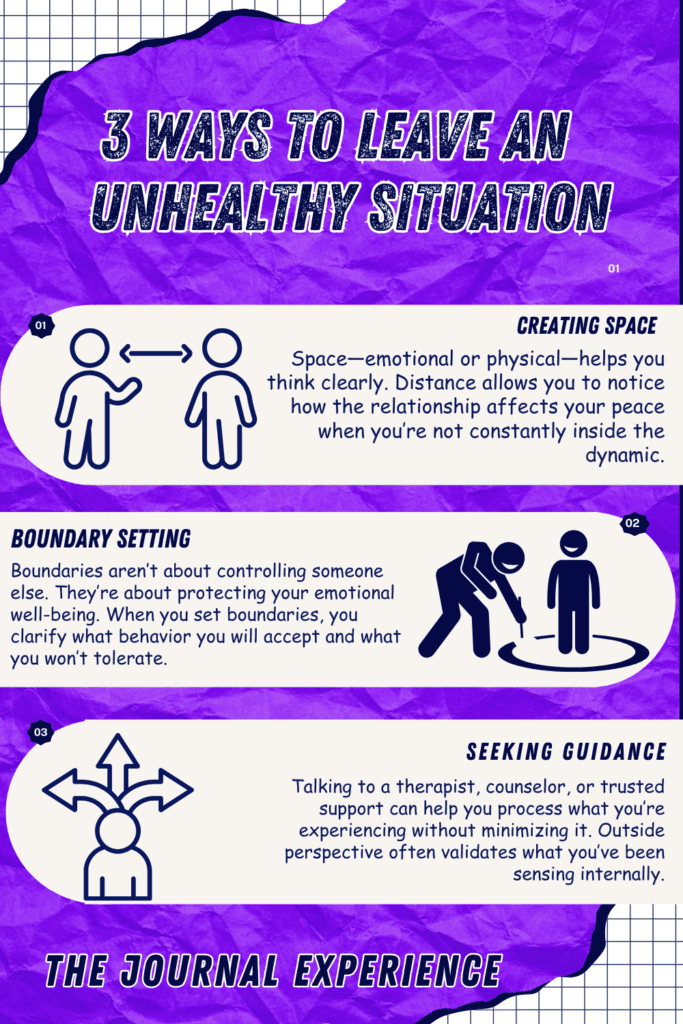
Boundary Setting
Boundaries aren’t about controlling someone else. They’re about protecting your emotional well-being. When you set boundaries, you clarify what behavior you will accept and what you won’t tolerate.
How someone responds to your boundaries tells you more than their words ever could.
Creating Space
Space—emotional or physical—helps you think clearly. Distance allows you to notice how the relationship affects your peace when you’re not constantly inside the dynamic.
Sometimes clarity arrives the moment you step back.
Seeking Guidance
Talking to a therapist, counselor, or trusted support can help you process what you’re experiencing without minimizing it. Outside perspective often validates what you’ve been sensing internally.
You don’t have to navigate this alone.
Overview
Unhealthy relationship signs don’t always look extreme, but they feel heavy. Confusion, anxiety, emotional exhaustion, and constant self-doubt aren’t personality flaws—they’re signals asking you to pay attention to what’s happening beneath the surface.
Healthy love doesn’t leave you questioning your worth or shrinking yourself to keep the peace. It feels steady, emotionally safe, and mutual. Awareness is where healing begins—and choosing yourself is not selfish.
If this post put words to something you’ve been struggling to explain, you don’t have to stop here. Inside The Journal Experience, you’ll find guided journal prompts, honest conversations, and supportive resources designed to help you process relationship patterns, reconnect with yourself, and make grounded decisions without romanticizing pain.